
Collecting: How Does One Determine a Collection's Value?
There are three levels of value to be assigned ... read on ...

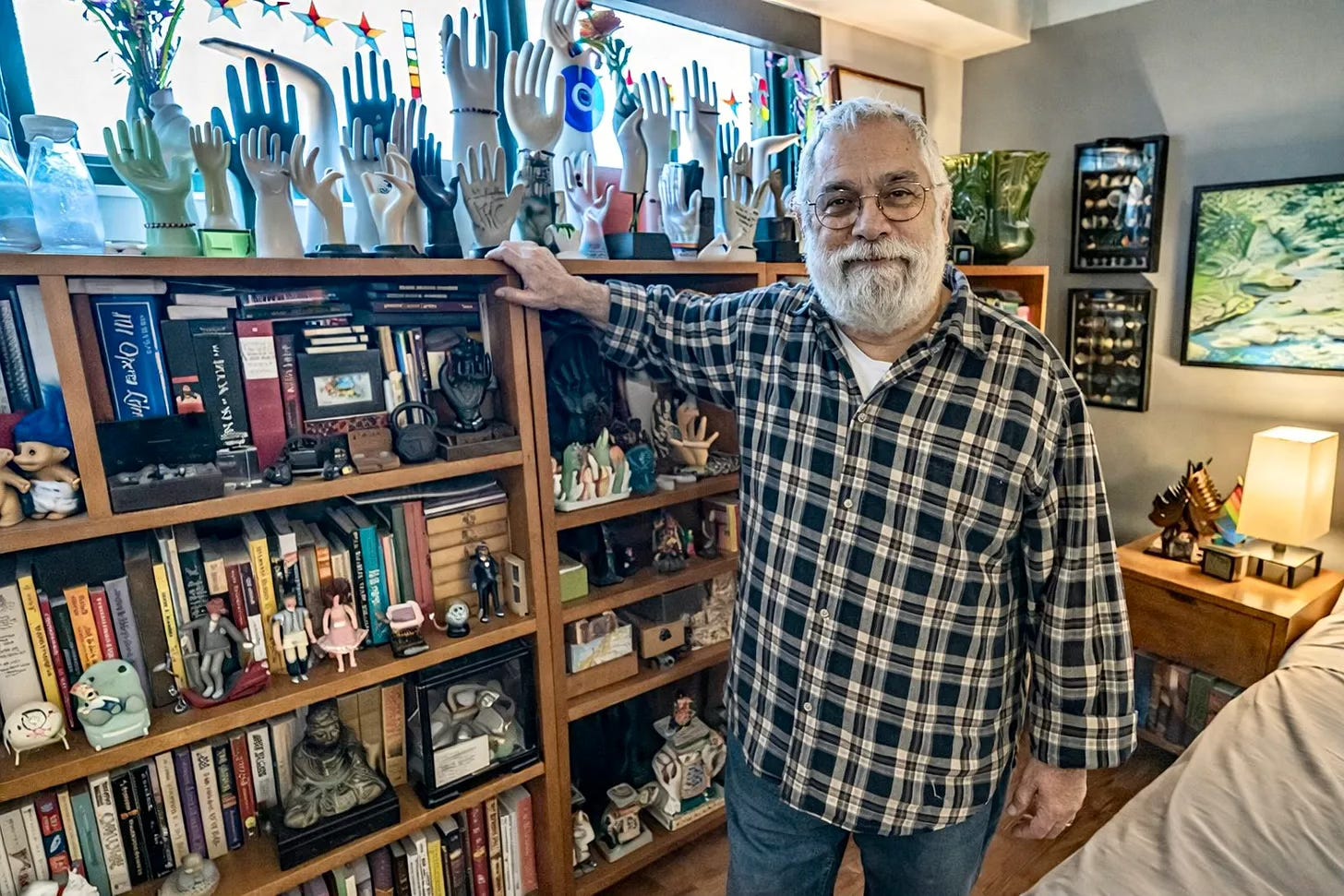
Michael and just a few of his collections. Photo by Alan Teller.
This essay was prompted in part by conversations with Paul Lukas in reply to my comments on his essay about people who catalog not only things, but their lives! Paul interviewed me not too long ago about being a collector, my curation of two museums, why I collect, why I think other people collect, and the differences between collecting and hoarding.
It ends with a full photographic study of the condo collections.
My reply to Paul
Interesting to read about others’ need to document their possessions. With all that I have at Chicago Children’s Museum and in my condo (Museum #2) I have never felt the need to document the items. I did name each collection and counted “how many” in a few, but that was enough for me. My husband used to joke, “If you knew exactly how many items you have in your collections at Chicago Children’s Museum and in the condo, (hundreds of thousands of them) it would probably make you claustrophobic!”
Fondly, Michael
Paul’s reply to me:
Hi, Michael! Glad you weighed in -- I was wondering what you'd think of these projects. Personally, I love stuff and I love catalogs, but I don't feel the need to catalog my stuff!
My reply to Paul’s reply:
One more interesting idea I learned came from the appraiser and me working together to assign value to my collections before they were moved to the Chicago Children’s Museum.
Before I met with the appraiser, I was terrified of having to catalog each of the hundreds of thousands, maybe millions, of items in my donation to Chicago Children’s Museum. He was an expert appraiser and also owned an antique shop that dealt with oddities and unusual “antiquities”. I was impressed when he asked us to work together to assign value. He explained that since I collected them, I, too, was an expert in the appraisal field, knowing how much I spent and, in my travels, what similar items cost.
We named each collection, wrote a brief description of its contents, and then assigned a value to the entire collection. His theory and practice were that if ANY ONE PART of the collection, in transferring to CCM, was lost, damaged, or destroyed, for insurance purposes, that would invalidate the entire collection and thereby initiate the insurance replacement cost for the entire value.
What sufficed was to take a photograph of the collection, describe it, and then estimate the total replacement cost. If, of course, the items were irreplaceable, the estimate would be higher. A second interesting fact is that estimates for items I had collected for my personal enjoyment and kept in my home would be lower than those for items that were part of an exhibit in an established museum.
So he did two lists, one reflected a lower estimate for each collection, and then he increased the value by quite a bit when the collection was installed at the Chicago Children’s Museum.
The only reason we needed an estimate of value for my collections was because of the unlikely possibility of them being lost or damaged on the trip from my home, to storage, to the museum, to their home in the permanent exhibit at the museum.
My personal philosophy is that I do not want to know the value of the items I still possess. Now that I have gifted the first run of collections to Chicago Children’s Museum, I no longer consider them mine.
But the items in my condo, I have not yet counted how many collections or how many items, most likely would add up to a value of 5 figures ($00,000). That is the approximate value for the children’s museum collection. For so many years, now that I am older, I have been able to purchase items that are a lot more expensive than the ones I collected when I was younger. And that means the dollars have added up.
But I do not collect in the hope that I will someday sell something and make a fortune off of its increase in value over time. I collect things because they buy me, I fall in love with them, they peak my aesthetic values, they are unique, they remind me of my childhood, they have stories to tell, they still carry the spirit of their previous owner, they allow me to have more of the same and I always say, “There is magic in repetition”, and more.
If there was, Spiritual Universe forbid, a fire in the condo, I would not try to save anything. It would be easier to let them all go than it would be to try to pick a few things that I value. It would be easier to remember them all with fondness than to mourn the loss of most of them.
So to try to sum up the title of this essay: “Collecting: How Does One Determine a Collection’s Value?”, my summation would be, “Who cares! What value just enjoyment?”


Next week, an in-depth description, evaluation, and appraisal of Michael’s Museum: Evanston Campus Condo Collections.
It's great that you have photos of your collections. I think they would help if you ever needed to determine a value in case of a fire or some other disaster. Your collections are so well organized!